Everyone learns Python in different time spans. Factors such as your targets, time spent studying weekly, and your unique practice approach all dictate what you learn successfully. If you build projects and practice consistently, you will learn more than someone who simply watches videos.
In this article, we provide you with timelines that are more realistic and also show you how you can learn more in less time.
Answer: Learning Timelines (Based on Goal)
If you are looking to learn Python, here are some realistic time spans:
- Python Basics (syntax + logic): 2 to 6 weeks
- Practical Scripting (small real tasks): 1 to 3 months
- Project Ready (finish small projects alone): 2 to 6 months
- Job Ready (role based skills): 4 to 12 months
By knowing the basics of programming, you can move faster. If you are not practicing regularly, you will likely take longer.
What Learning Python Means (Pick a Target)
Most people are left confused and lost because they will often not define how long does it take to learn python. What is your target?
Level 1: Basics
You know:
- what variables, and datatypes are
- logic of if/else statements
- what are loops
- what are functions
- basic input and output
Level 2: Practical Python
You can:
- write small scripts for real world problems
- manipulate files and text
- manage typical errors
- debug small issues in a calm manner
Level 3: Project-Ready
You can:
- design a project for beginners
- split it in different steps
- complete it
- make changes to it based on what others say
Level 4: Job-Focused Foundations
You can:
- pursue a particular role (automation, data, web, QA)
- craft a portfolio-like project for that role
- write good, clean, and maintainable code
Choosing a level allows you to see how far you’ve come.
How Weekly Study Time Changes Everything
Your weekly commitment can speed up or slow down your timeline. Use this table as a realistic guide.
| Weekly Study Time | Basics (Level 1) | Practical (Level 2) | Job-Oriented Since Level 4 |
|---|---|---|---|
| 3–5 hours | 6–10 weeks | 3–5 months | 10–12+ months |
| 6–10 hours | 3–6 weeks | 2–3 months | 6–9 months |
| 11–15 hours | 2–4 weeks | 1–2 months | 4–6 months |
Consistency, not just “one long session,” matters more. Study most days and you will learn the material more quickly. How long does it take to learn python, always include your weekly hours in the answer.
What Hinders Python Learning (And How You Fix It)
Mediocre Python learning can usually be blamed on poor choices.
You are more of a watcher than a doer
Watching videos is not enough. You will not be able to grow as a writer and fix your code until you do it.
Fix: You should do a few problems your remember immediately after each lesson.
You avoid projects
Unless it is a group project, it typically will not force you to plan, debug, and finish. All of your knowledge will remain as knowledge unless you make it into a project.
Fix: Start small. It is okay if your project is not very complex.
You change topics too frequently
Jumping from the basics to web, data, or AI will prevent you from having a complete understanding of each subject and make learning Python extremely frustrating.
Fix: Only focus on one subject for 8 to 12 weeks.
You don’t like making mistakes
Mistakes show you what to improve. Debugging is not failing. Debugging is making progress.
Fix: Read the error message. Take your time. Only focus on the problem you want to solve.
You study without a method
Learning without a method leads to the worst outcome.
Fix: Implement a study system. Execute your objectives. Be methodical.
WHAT ACTUALLY SHORTENS THE LEARNING PROCESS
With the appropriate basic habits, you can learn faster.
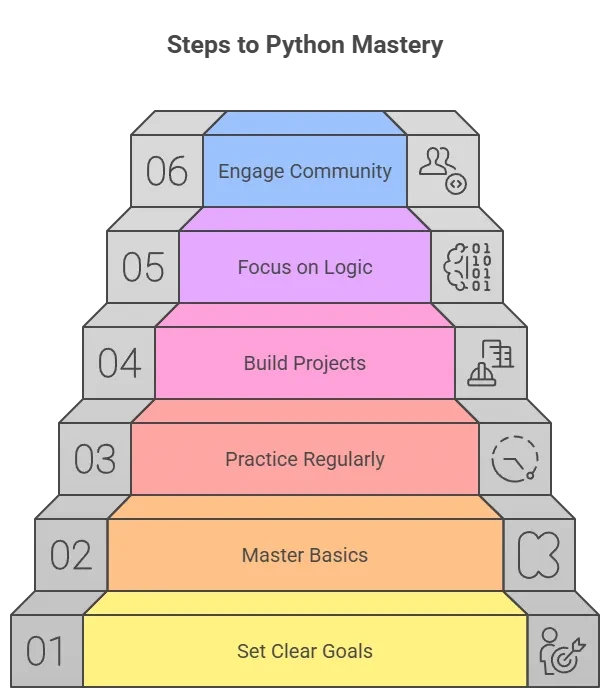
- Study 30 to 60 minutes almost daily.
- Write code. Read solutions afterwards.
- Master the basic. Start the next lesson when you feel comfortable.
- Document your mistakes.
- Start small projects. Complete them.
Your brain starts to recognize patterns when you program continuously.
Choose One Path (So You Learn the Right Skills)
Rapid learning is offered by automation, programming, and Python, which leads to various jobs.
Path A: Python for Automation (quickest wins)
You can automate repetitive tasks, and get quick results.
You usually learn:
- file and folder handling
- text processing
- CSV work
- simple APIs
- basic scripting structure
Typical timeline: useful skills in 1 to 3 months.
Path B: Python for Data Analysis
You work with datasets and create reports.
Some skills you are likely to develop are:
- data cleaning
- working with tabs
- basic charts
- basic statistical thinking
General Timeline: 3-6 months to feel confident working with real data.
Path C: Python for Web Development
In this path, you learn to develop APIs and web applications, as well as different concepts related to the web.
Most people will learn the following:
- HTTP and APIs
- databases
- basic authentication
- basic deployment
General Timeline: 4-9 months to develop solid beginner projects.
Path D: Python for Machine Learning
You are going to need a stronger foundational understanding of data and evaluation.
The majority learn the following:
- foundational data skills
- basics of model evaluation
- training/testing habits that are meticulous
General Timeline: 6-12 months to reach an adequate level of self-confidence.
Choose a path, and you will be able to add other paths later.
A Practical 8-Week Python Plan (Beginner Friendly)
This outline ensures that you will be moving along the plan without any major roadblocks.
Weeks 1-2: Core Basics
The core basics are as follows:
- variables and data types
- conditions and loops
- functions
Objective: to write several hundred lines of code without having to copy everything.
Weeks 3-4: Data Structures and Logic Practice
Understand how different types of data are and can be organized by Python.
Most will learn the following:
- first, lists and dictionaries
- then, tuples and sets
- basic search and filtration
Objective: to be able to use the right data structure.
Weeks 5-6: Real Inputs + Debugging
Begin to work like an actual programmer.
- Start reading and writing files
- Managing messy input
- Understand error messages
- Get your practice fixing bugs
Goal: Debug more calmly and improve your code.
Weeks 7-8: Build Two Small Projects
Projects can offer more than lessons can.
Choose 2 simple projects such as:
- quiz app with scoring
- mini expense tracker
- text cleaner
- log checker that finds errors
Goal: Finish both projects and write a cleaner version 2.
How You Know You Are Improving (Clear Checkpoints)
Checkpoints help measure progress. You shouldn’t think of progress as “I finished a course.” Progress can be more functional.
You reach a strong beginner level when you can:
- write small scripts without copying everything.
- explain code with simple words
- use the error message to fix the error
- use the functions to avoid repetition
- confidently manipulate lists and dictionaries
You move toward intermediate when you can:
- break a small project into manageable structures
- manage edge cases (empty input, wrong format)
- test using different inputs
- keep your code readable with appropriate auspices
These checkpoints show real skill.
Common Mistakes that Waste Months
Here are mistakes that will make your learning process way longer.
- 1) Tutorial addiction: Tutorials make you feel productive, but they don’t help you develop your own skills.
- 2) Weak fundamentals: Learn loops and functions inside and out.
- 3) No practice schedule: To learn something, you gotta do it over and over.
- 4) No finishing: It’s good to start, but it’s better to finish because finishing something helps you learn and develop your skills.
- 5) Comparing yourself to others: The only important thing is your own learning and progress, so track your progress each week to see how far you’ve come.
Final Summary: How Long Does It Take to Learn Python?
If you only want to learn the absolute basics of python, then you won’t need more than a few weeks. If you want to learn python for a specific purpose, you will need more time (usually several months). Wanting a job that requires you to know how to use python will require you to have job-related skills, which will require you to know python for 4 – 12 months, depending on your goal and the time you spend learning each week.
If you want to improve faster, do the following: practice almost every day, work on small projects, and learn how to debug as early as possible.
FAQs
1) How long does it take to learn python for a beginner?
New beginners learn the absolute basics in 3-8 weeks if they practice regularly.
2) Can I learn Python in 30 days?
You can learn the basic commands in 30 days, but for practical experience and to have confidence in using it, you’ll need more time.
3) How many hours a day should I study Python?
If you want steady progress, try studying Python for 30-60 minutes daily, but feel free to increase your study time if you’re able to be consistent.
4) Is Python hard to learn?
The syntax for Python is simple, while problem solving and debugging will take longer, but practice will help you.
5) What is the quickest way to learn Python?
To learn Python, you need to practice every day, try to remember and solve small problems, and work on little projects.