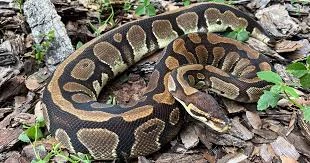
When looking up how big a ball python gets, enclosure choice, feeding price, ease of handling, and long-term care will all be influenced by python size. Ball pythons are medium sized snakes, but individual adults have a wide range of sizes.
Here, I will outline the average length and weight of adult ball pythons, the differences between females and males, the expected growth rate, and the various factors that will control the size of pythons. I will be writing it in US English and have a clear and repetitive structure.
Ball Python Adult Size: What Is Typical Length?
When kept at a stable temperature and feeding schedule, most pet ball pythons are able to fall into a predictable range.
Typical adult length
- Adult male: about 2.5–4 feet (0.75–1.2 m)
- Adult female: about 3–5 feet (0.9–1.5 m)
A simplified average would be about
- Male: roughly 3–3.5 ft
- Female: roughly 4–4.5 ft
When people ask how big does a ball python get, the most helpful answer would be about “3–5 feet” with females landing at the more upper range
Ball Python Weight: How Heavy Does a Full Grown Ball Python Get?
Only knowing a snake’s length doesn’t touch the full picture. The weight reflects the overall body condition, feeding history, and individual structural body design. Weight can really vary.
Typical adult weight
- Adult male: roughly 700–1,500 grams
- Adult female: roughly 1,200–2,500 grams
Some females can exceed 2,500 g, which should not be taken as an automatic indicator for good health. Obesity can show on an overweight ‘big’ snake. So a healthy body condition matters more than just a big number.
Male vs Female Size: Why Females Often Become Larger
Ball pythons show some sexual dimorphism. Females generally:
- grow a bit longer
- reach a higher weight
- keep thickening over a longer time
This pattern reflects biology, not just care. In many breeding species, females have an advantage from having more body mass, allowing them to support eggs and survive multiple breeding cycles. However, the differences are not enormous and individual variation can be more influential than that general rule.
If housing is your primary consideration, and you want a smaller, typically simpler to house adult, then assuming a male is a safer bet. However, if your preference is for a larger, more robust animal, most keepers opt for females, though you should still be aiming for a healthy structure rather than bulk.
Growth Timeline: What is the Growth Rate of Ball Pythons?
Many people search the query how big does a ball python get in reference to looking at a baby snake and wanting to know the adult size, attempting to forecast the expected size. While you can make a prediction based on the current size, there is no certainty due to the influence of genetics, feeding, and the overall care provided.
A realistic growth chart (general expectations)
0–3 months (hatchling)
- Length: 10–16 inches
- Weight: 60–150 g
- Notes: Stable heat and secure hides help establish reliable feeding.
3–12 months (juvenile)
- Length: 18–30 inches
- Weight: 200–700 g
- Notes: Growth can look steady if husbandry remains consistent and reptiles eat well.
1–2 years (sub-adult)
- Length: 2.5–4 feet
- Weight: 700–1,500 g
- Notes: Many males approach adult length in this window.
2–4+ years (adult filling out)
- Length: changes often slow down
- Weight: body can continue to gain as it thickens
- Notes: Females commonly keep adding mass longer than males.
Ball pythons exhibit a variety of growth patterns. There are what are called feeding strikes, sheds which may cause a loss of appetite, and seasonal behaviors which can cause a change in feeding. For these reasons, tracking body weight over time can offer a good view of normal progress.
Maximum Size: How Large Can a Ball Python Get?
Yes, there are atypical cases of extremely large ball pythons. However, these are rare.
- A ball python over 5 feet is generally large.
- A ball python close to 6 feet is extremely rare.
A seller stating, “guaranteed 6-foot ball pythons” are making wild claims. Look for healthy conformation, good disposition, and solid husbandry history, as these factors impact health far more than a few inches.
Factors that affect the final size of an organism can fluctuate, and this is especially apparent in two ball pythons of the same clutch that can grow to have conspicuously different body builds. The most likely variables that can affect size are:
1) Genetics and lineage
Some lines trend larger or smaller, and while breeders can track those size trends, they are not guaranteed for pet buyers. When looking up how big does a ball python get, the size of the lineage should be considered more of an influencing factor over the guarantee.
2) Feeding schedule (the most impactful variable)
A feeding schedule can affect how large a ball python will grow as well. If a ball python is overfed, it can cause the ball python to grow heavier at a quicker rate, but this can also raise the risk of obesity and eventually shorten the ball python’s lifespan.
A regulated feeding schedule does the most good:
- For juvenile ball pythons, approximately every 7–10 days
- For adult ball pythons, approximately every 14–21 days
The length of a ball python is not influenced by feeding at a higher frequency, but the width of the ball python is.
3) Temperature and digestion
Ball pythons, along with their habitat, should also have access to a thermal gradient so that they can move to different temperature zones to better regulate their body temperature. If the temperatures are too cool, digestion rate will slow, and the appetite will drop as well. If the temperatures become too hot, or too temperature unstable, it can also cause stress and negatively affect the overall health.
When ensuring optimal and stable conditions, best practice is to use a thermostat for any heating sources, as this will ensure readings remain consistent.
4) Enclosure design and stress levels
A stressed snake will often refuse to eat. This can cause stunted growth and negatively impact body condition.
Common sources of stress include:
- oversized hides
- open layouts with no cover
- too much handling, especially after feeding attempts
- busy pets and people
- humidity spikes during shedding.
A calm enclosure will compass stressed snakes and enable consistent feeding.
5) Health issues and parasites
Chronic conditions or internal parasites can cause reduced appetite and slow weight gain. A drop in weight irrespective of adequate temperatures or a long refusal period are indications and exotics vet and fecal check are in order.
Measuring a Ball Python Correctly and Safely
Most snake owners’ claims are too short as snakes tend to not lie out straight. Use methods that are calm and do not encourage them to stretch.
Preferred Methods of Measuring
Option 1: String method
- Let the snake move freely across a surface.
- Trace the body along the string, touching, but don’t pull.
- Measure the string with a measuring tape.
Option 2: Image reference method
- Take a top-down picture. Make sure a measuring tape is in the frame.
- Use the image to estimate length as a reference when necessary.
Never forced stretching. Stretching is likely to cause injury and is stressful. If you’re still wondering how big does a ball python get, understand that measuring is much better than just guessing.
“Big” vs “Healthy”: Judging Body Condition the Right Way
To understand how big does a ball python get in a practical sense, you must understand the body condition of a healthy snake over time.
Body Condition Signals
- The body, when viewed laterally, is a gently rounded triangle, and is not sharply so.
- Spine is not visible.
- The snake, when palpated, is solid and not squishy.
- The tail tapers gently.
Obesity indicators (relevant to all pets, so avoid)
- Instead of soft-angled, the body appears round, or cylindrical.
- When coiled, fat rolls or creases are visible.
- The base of the tail is thick, or “sausage-like.”
- After being handled, the animal appears to labor far more to breathe than is normal.
While many people presume heavy snakes are healthier, that is most certainly not the case with ball pythons. In fact, most ball pythons do best when maintained at a lean, fit condition that enhances activity and increased longevity.
Determining Enclosure Size Based on Expected Adult Size (Practical Planning)
People search how big does a ball python get because they want to know how many times they will have to upgrade tanks. This is because enclosure sizing should reflect what an adult ball python will need.
Realistic practical sizing based on average adult size
- Juveniles: smaller enclosures can work temporarily, but have an upgrade plan in place early.
- Adults (recommended standard for most keepers): 4 ft x 2 ft x 2 ft enclosure is often appropriate for most adult ball pythons.
The three most important factors affecting comfort are:
- The number of snug hides (at least one warm and one cool side)
- Reliable thermostats and proper heating
- Enough clutter/cover for the snake to feel secure.
An adult snake that is securely settled also tends to eat more frequently and is better maintained. This leads to a better understanding of realistic size expectations and healthy growth.
Handling and Size: What 4-5 Feet Feels Like in Real Life
To most owners, a 4-foot ball python is not all that intimidating. It is strong, that much is true, and it is best to handle it calmly with support.
Handling a larger snake will have the following differences:
- Support the length of the snake instead of “holding up” one end.
- The snake will grip, so steady hands and gentle pressure are best, and grip is less than the snake to force.
- Heavier than expected, due to high muscle density.
Even with ball pythons, the most important factor is support and style. Respect and routine is the most important factor, more than restraint.
FAQ (Quick Answers)
Q1: Are ball pythons fully grown or adult at a certain age?
Males typically reach near adult length by 2-3 years however females can still continue to grow in diameter and typically are not “done” at this age milestone.
Q2: Does a morph affect how big a ball python gets?
Most morphs won’t cause a size shift. Genetics, feeding and behavior typically have a bigger influence. Some lineages in morphs have a slight trend to be smaller or larger, but this is usually not practical.
Q3: do ball pythons grow bigger in captivity or in the wild?
Due to food being supplied in a predictable way, they can weigh more in captivity. However, many adults reach the same length ranges in both wild and captivity. Feed them responsibly to prevent obesity and then they can be healthy adults.
Conclusion
To answer how big does a ball python get, females get an adult size of 3-5 feet while males get an adult size of 2-4 feet. Also, ball pythons can get a few inches bigger per year for the first few years of their life, while in the later years they will “fill out” instead of grow more in length. Lastly, steady husbandry, temp and feeding will determine the python’s size and health much more than a specific size target.