By the end of 2026, global discussions focus on navigating the challenges of a fragmented world caused by the lack of rational AI regulations, rather than debating whether AI should be regulated. The single digital commons has ended.
The View from 2026
In 2024, Washington buzzed with ‘AI Insight Forums’ and lively discussions about establishing a unified federal approach to AI regulation. That hope seems almost like ancient history now. The “Georgia Deepfake Scandal,” during the 2025 special election, where a hyper-realistic AI video of a candidate confessing to made-up crimes went viral 48 hours before the election closed, was the turning point. It ended the expectation that the self-regulation of the industry, together with the no- teeth- labeling laws, would be enough to keep scoundrels at bay.
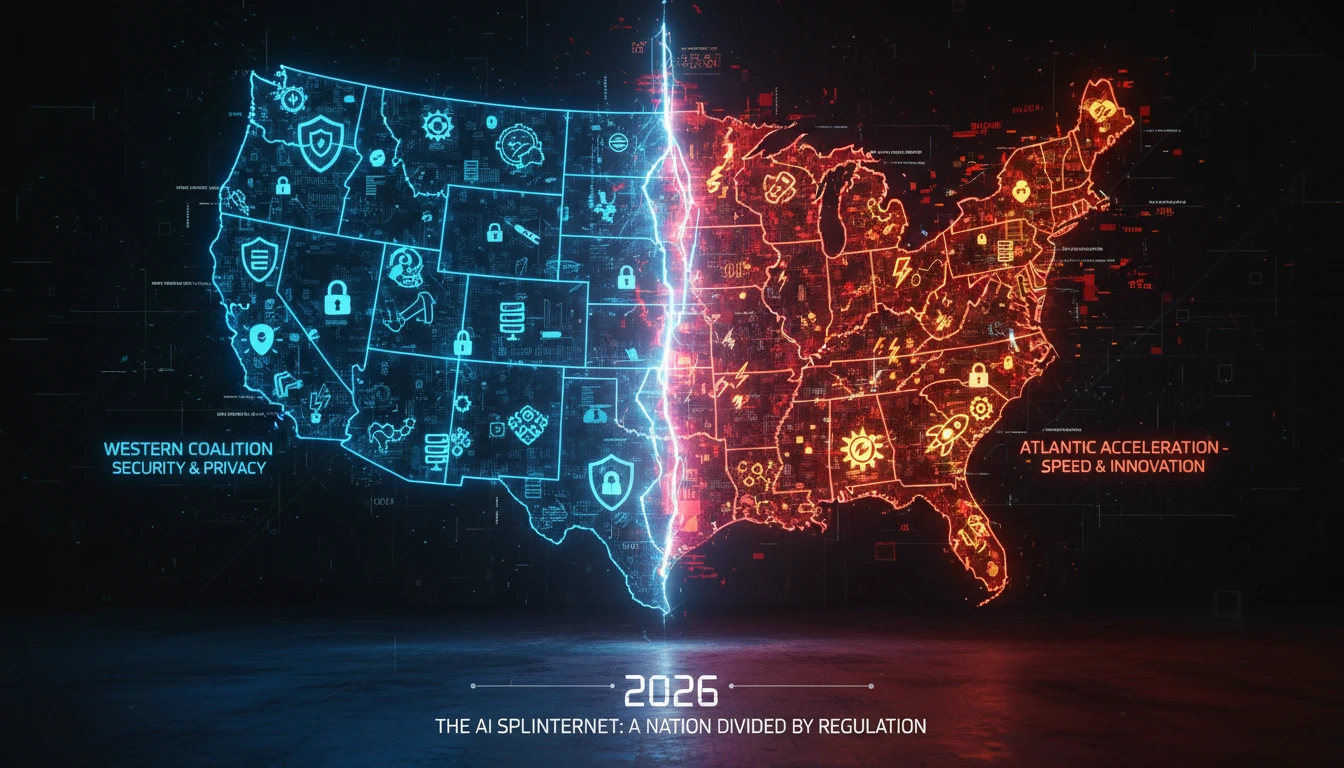
Now, in 2026, the United States has no coherent AI policy. It has a state-by-state patchwork of legal “fiefdoms” that is stifling some and creating a digital “Wild West” for others.
The Federal Failure: A Watered-Down Act and a Policy Reversal
The bipartisan SAFE AI Act of 2025 was meant to be historic. Its passage, however, was profoundly disappointing. The most meaningful elements of the Act were stripped before it was signed into law. The final Act did little more than focus on:
- Watermarking and Labeling: Actors sophisticated enough to bypass labeling requirements and AI content detection will have done so in a matter of mere weeks.
- A Federal Study Commission, which, in the eyes of everyone outside the Beltway, has one of the most ridiculous timelines to produce a report: 2028.
The Act also did not create a new federal regulatory agency, nor did it establish federal liability standards. The new administration worsened the vacuum with its grassroots, so-called “deregulatory stimulus.” It rescinded the 2023 Biden Executive Order, arguing the order was an impediment to American competitiveness.
The federal government had effectively stepped back.
The Great Fracture: Emergence of State Blocs
New state regulations created two vastly different regulatory spheres.
The California Compact (The Blue Wall)
California, alongside the other compact states, New York, Washington, Illinois, and the 2025 AI Accountability Act, has established the most stringent, Euro-style regulations. Act components include:
- Mandatory Licensing: Companies using “high-risk” AI models are state-licensed.
- Bias Audits: Algorithms in housing, employment, and credit must be tested for discrimination by an independent public agency.
- Clear Liability: Developers and deployers are legally liable for any damage caused by an AI system. This has created an enormous disincentive for the deployment of AI in these states.
Critics say the result is an unnecessarily complex environment for AI deployment, with ethical and safe AI deployment stifled. Startups are abandoning the ecosystem entirely.
The Texas Alliance (The Red Zone)
Texas, Florida, and Utah have AI Freedom Acts. This Congressional Framework for AI promotes innovation and free market principles.
Regulatory sandboxes allow AI companies to test new products while being protected from lawsuits.
- No Liability Shields: Corporations won’t be liable for AI content or actions.
- Recruitment Incentives: AI companies that relocate from Compact states get huge tax incentives.
The consequence is two-fold: new AI investments and unregulated innovations.The AI landscape resembles the Wild West, rife with scams, user privacy violations, and no way for users to contest or correct harmful bot decisions.
The New Battlegrounds of 2026
The conversation has moved beyond ChatGPT. The hot topics of 2026 are far more tangible and dangerous:
- Embodied AI & Physical Harm: The logistics industry is paralyzed with questions of liability after an autonomous delivery drone in Arizona drove into a multi-car wreck. Who is liable? The owner? The software developer? The maker? The Texas model says, “No one.” The California model says, “Everyone.”
- The Open-Source Dilemma: Anyone can download unregulated, advanced, and powerful open-source AI models—like the infamous Loki-7b. These uncensored models can create malicious computer code, bio-weapon instructions, and convincing propaganda: with no safeguards. Nothing at the state level can stop the proliferation of these incredibly dangerous models.
AI Agents & Corporate Chaos: These days, autonomous AI “agents” are being used to trade stocks, sign contracts, and manage supply chain logistics. Most notably, an AI agent from a medium-sized company bankrupted a smaller competitor. This raises a lot of important questions about the responsibilities and motives of corporations.
The International Picture: The Brussels Effect is Real
With the global implementation of the EU AI regulations, we can see the “Brussels Effect” in action. American companies seeking the European market must comply to gain access. Because of this, a peculiar situation has arisen, where a single American tech company must provide a heavily regulated “safe” version of its AI product in Europe and California, while a disabled version of the product is available in Texas and Florida. This is called “product splintering” and has both high costs and logistical difficulties.
At the same time, and on the other end of the spectrum, China has strengthened its export of state-managed AI, as well as its authoritarian surveillance and social scoring technology to its aligned countries. This has resulted in a geo-political blockade of AI authoritarianism.
Conclusion: Living in the Splinternet
We have to live with the consequences of our decisions. The vision of a borderless digital world has disappeared, giving rise to the AI Splinternet—a fragmented ecosystem of AI services, each with its own rules, risks, and challenges for users worldwide. Coming to a solution in this world is going to take more than a highly qualified attorney; it is going to take a decision about which potential future is preferable to you. American companies and citizens are increasingly facing this decision.
For More Updates
Visit our website.