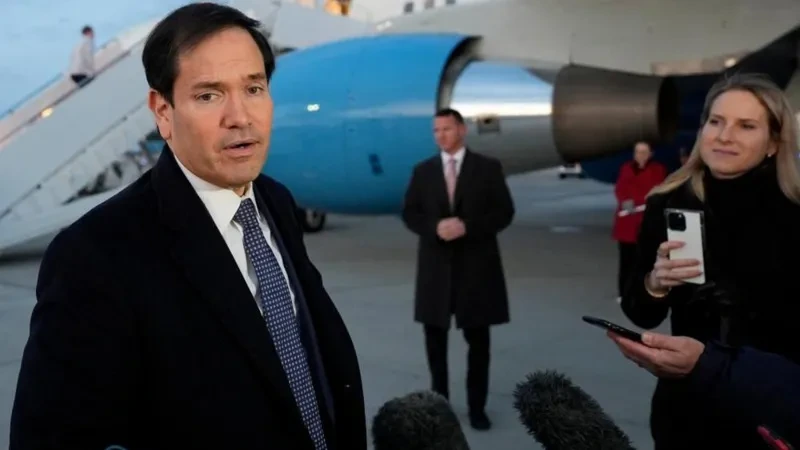
US secretary of state Marco Rubio arrived in Europe for the 2026 Munich Security Conference, claiming that the transatlantic alliance has entered a defining moment Rubio’s comments are noticeably less hostile than the wrecking ball comments from the US delegation last year, which described the European diplomats as cannon fodder.
The Old World is gone, said Rubio, We live in a new era in Geopolitics, and it is going to require all of us to re examine what that looks like and what our role is going to be.
Changing of the Transatlantic Ties
The Munich Security conference opens with more transatlantic tensions than ever before. Just over 1 year ago, Vance, during the same conference, launched a diplomatic incident by criticizing European immigration and free speech policies. Since that moment, relations have continued to deteriorate following Trump’s threat to annex Greenland and Trump’s trade tariffs.
Despite these disagreements, Rubio pointed out that the U.S. is still ”deeply tied to Europe.” However, he noted that the classical ”security umbrella” that has characterized the post-World War II era has fundamentally changed.
Europe Must Learn to Stand on Its Own
German Chancellor Friedrich Merz was the first speaker at this conference, and he gave the clearest endorsement of European self-reliance. Merz argued that the U.S. adopting an ”America First” isolationist policy should not lead Europe to view this shift as an ”inevitable fate.”
The United States claim to leadership has been challenged, and possibly lost,” Merz cautioned. He depicted a dangerous ”zero-sum game” in which dominant powers exploit natural resources and supply chains as means of trade. He called on European countries to ”step up together with determination” to cope with the geopolitical crisis.
Most Pressing Topics at Munich
The upcoming three-day summit with over 50 world leaders, including France’s Emmanuel Macron and UK’s Keir Starmer will address the most pressing issues:
- Ukraine and Russia: President Volodymyr Zelensky has been reported in Munich as in transit to U.S.-sponsored peace talks in Geneva that are set to occur on February 17-18.
The Greenland Dispute: Danish Prime Minister Mette Frederiksen is likely to meet Rubio over the U.S. threats to confiscate the semi-autonomous territory, which puts further strain on NATO relations.
Defense Spending: European countries are facing challenges in responding to the latest NATO requirement of spending 5% of GDP on defense by 2035, which, per Dutch Foreign Minister David van Weel, is a ‘big sacrifice.’
A ‘Force-Multiplier’ or ‘Charity’?
Just as the conference commenced, 16 former U.S. NATO ambassadors and military leaders published an open letter calling on Washington to continue its support for the alliance.They said NATO acts as a “force-multiplier.” They said the U.S. would have to spend much more to keep its influence.
Conference chair Wolfgang Ischinger disagreed. He said the White House’s current foreign policy has triggered a new dynamic. He said its full effects have not appeared yet.
Rubio will likely sound more conciliatory in Munich than Vance. But a question remains. Can the U.S. and Europe still agree on the international order? Or has unqualified cooperation ended?
For More Updates
Visit our website.