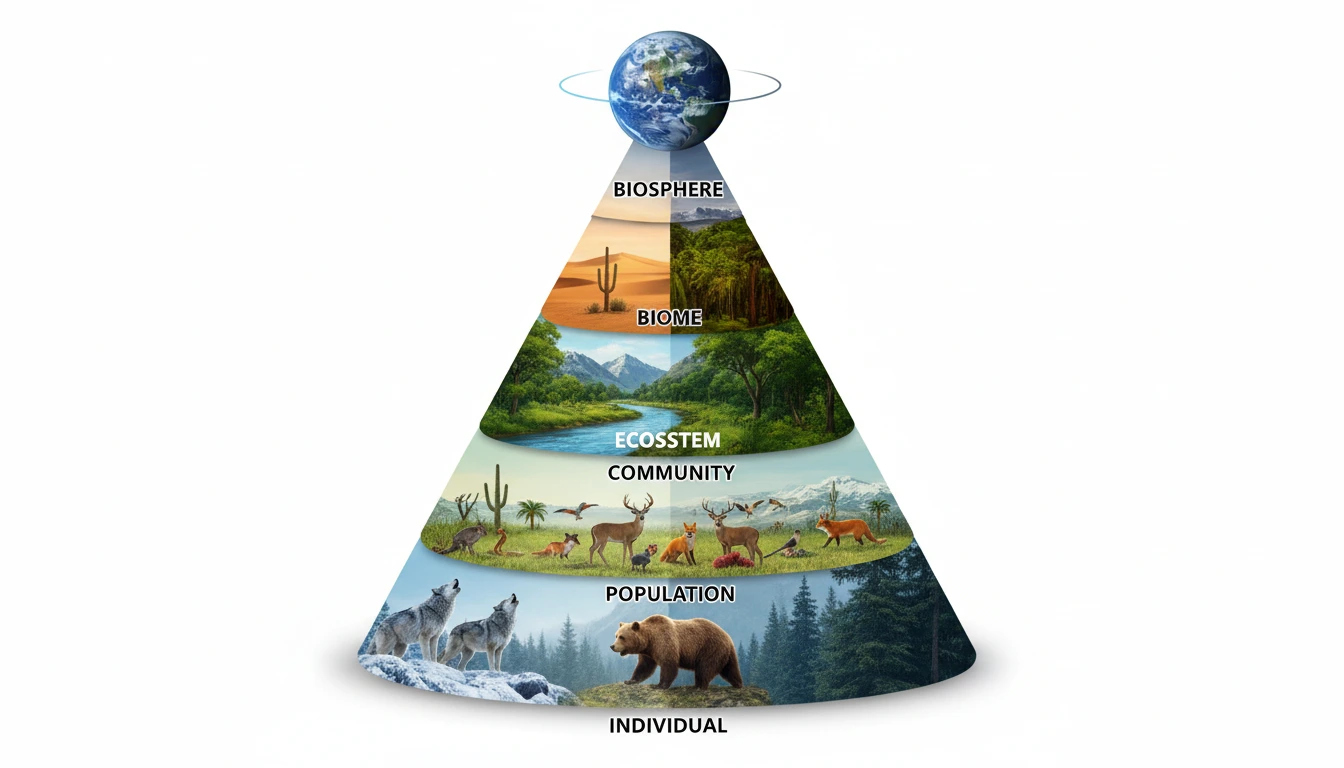
Different from the study of Ecology’s approach of looking at the overwhelming multitude of nonliving and living components making up the ecosystems, Ecology looks at a well ordered structure and a highly structured hierarchy where everything living has a specific place and role.
The Levels of Organization guides the study of ecology from the simple to the complex (the entire planet), and here, we zip through the six levels of ecosystem organization of the whole world.
1. The Individual (Organism)
The Individual is the most basic element of ecological organization.
- Focus: Students of science at this level concentrate primarily on how one living being survives, how one living being adapts to a particular environment, and how the physiologic of one living being reacts to some stimulus of the external environment, like changes to temperature, N, P, K food availability, or living organisms.
- Example: A single Goldfish.
2. Population
A Population is a collection of Individuals of the same species and same place at the same time.
2. Population
A Population is made of members of the same species living in a particular area. In Population Ecology, scientists study growth, decline, and movement of individuals in a population. Important factors are birth and death rates, and resource competition.
- Example: All the Goldfish living in that particular pond.
3. Community
A community forms when populations of different species live together and interact in the same environment. It includes only biotic (living) factors.
- Focus: At this level, scientists are interested in the nature of relationships among different species. This includes predation (who eats whom), competition for living space, and symbiosis (a win-win situation).
- Example: The Goldfish, the frogs, the lily pads, and the dragonflies all interacting in the pond.
4. Ecosystem
The Ecosystem level is a major turning point because for the first time, Abiotic factors (the non-living part of nature) are considered. An ecosystem consists of a biological community and a physical environment.
- Focus: Ecologists study how energy flows through food chains and how nutrients cycle through living and nonliving components.
- Example: The entire pond environment, including the water quality, the sunlight reaching the bottom, the rocks, the mud, and all the living organisms.
5. Biome
A Biome is a huge area on the earth that has a particular kind of climate, rainfall, and a certain kind of life like plants and animals. A biome is made up of many different ecosystems that have similar conditions.
- Focus: The focus on this level is the life on earth and how different climates and regions affect the life.
- Example: The examples of this are the Tropical Rainforest, or the Sahara Desert, or Arctic Tundra.
6. Biosphere
Biosphere is the last and the most complex level of organization. It includes all the regions of the earth that have living organisms from the deepest trenches of the ocean and the highest part of the world.
- Focus: At this level, the focus is the global patterns which affect climate change, the carbon cycle, and the transfer of energy across the atmosphere, water, and land.
- Example: The example is the earth.
Why Do These Levels Matter?
Understanding the levels is very important for the science and conservation of ecosystems. For example, if a scientist wants to save an endangered species, then the scientist has to look beyond the individual and understand the framework of its population and community and its ecosystem level.
When we learn about these levels, we see how everything is connected. For example, a change in the global Biosphere like global warming, can impact an Individual organism living in a pond.
For More Updates
To keep up to date with the latest on global relations, please check our website.