




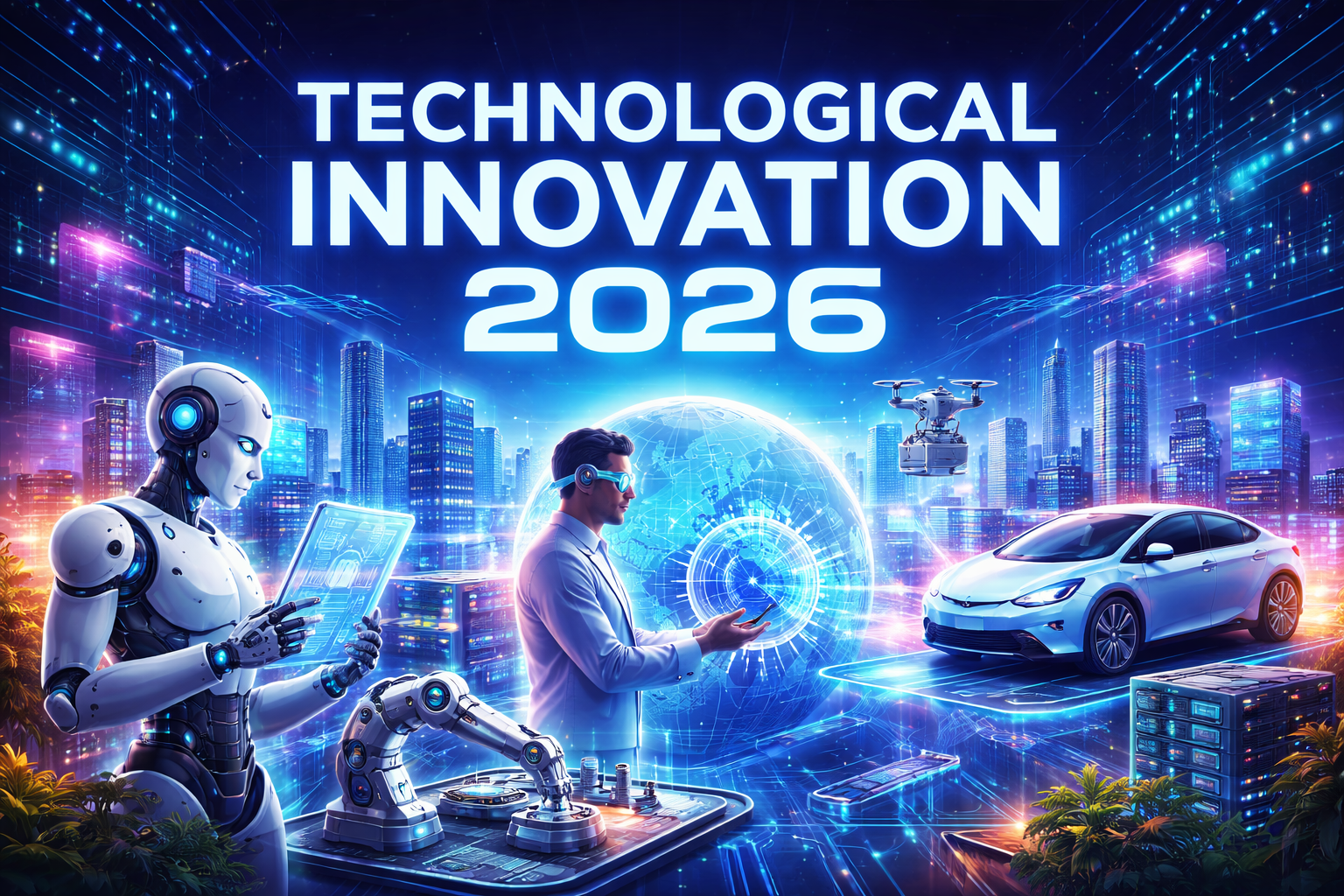
Technological innovation is the process of putting new technologies into use in order to gain efficiency and solve new problems in new ways across all industries. It encompasses more than creating new tools. It also happens when businesses use new methods to improve the way they work, provide and support services, and interact with customers. In 2026, the latest innovations in technology-based business strategies have become vital elements of growth for American and world businesses. Innovations in the areas of AI, machine learning, cloud computing, blockchain, and more are redefining the ways in which businesses solve problems, streamline operations, and provide value to the people who are working with them. Resisting innovation will put businesses at risk of succumbing to a world where everything is digital.
Technology affects society in many ways apart from its positive influence on businesses. Healthcare systems can deliver fast and more precise diagnostics. Financial services can provide more accurate transaction protection. And in retail they can provide a more adaptive shopping experience. Technology and innovation lets businesses solve more complicated problems easier, automate processes, and make data based driven decisions. It allows businesses to do more than what was previously thought to have been possible. Businesses that are willing to embrace rapid change and commit to incorporating technology in their processes will achieve long term success.
What is Technological Innovation?
What is Technological Innovation? For simplicity, we categorize innovation into two types: incremental and disruptive. Incremental innovation improves existing systems and processes by applying new technologies or optimizing current methods. Disruptive innovation, in contrast, introduces groundbreaking solutions that transform industry standards and replace previously accepted practices.These processes are necessary to business growth and it is therefore important that business find a balance between the two innovations also referred to continuous and breakthrough innovation respectively.
Businesses require research and development to create new technologies. The firms that spend their time and money on research and development are able to to utilize new innovations, work with new technologies, and provide solutions to fulfill market demands. Startups take the lead on this the most because they are able to take on the most risk and are the most creative. Long established businesses have the most to gain by integrating research and developed solutions into their businesses because they are able to expand their already established and well known service to the rest of the world. The adoption of new technologies improves the work of businesses by simplifying tasks and improvements keeping the strong and competitive work they already have.
Digital Innovations
Digital innovations are the new technologies that are the result of innovations in the new software technologies that have recently been developed. Business owners are now using tools driven by AI, Data Analytics, and Robotics in order to facilitate and optimize their business processes. These tools help businesses reduce operational inefficiencies, optimize processes, and deliver more complete and flexible customer service. By continuously updating workflows, companies can offer better market solutions. In product innovation, businesses leverage new technologies to create entirely new products that meet emerging market needs. These could include smart home technologies, autonomous vehicles, wearable technologies, and IoT devices. Aside from serving a functional purpose, these products also provide an opportunity to stand out from other organizations in the market. The businesses that prioritize product innovation are able to obtain new target markets, foster brand loyalty, and become leaders in the industry in regard to advanced technologies.
Process Innovation
The use of technology to optimize operational management in business is referred to as process innovation. The use of AI, machine learning, and robotics on production and services lines, as well as within supply chains, can help to improve and increase productivity and decrease the number of mistakes made. The refinement of internal operations through innovation will also result in an increase in efficiency, better quality of work, as well as a positive effect on the company’s profitability through the decrease in costs. Additionally, process innovation may include the use of alternative methods to optimize the operations of a business continuously.
Business Model Innovation
When business model innovation happens, businesses use technology to alter their creation, delivery, and capturing methods. Some examples include subscription business models, software as a service (SaaS) businesses, online marketplaces, and other innovative business models to reinvent old models. Businesses may alter their profit models and customer relationship approaches in many ways, and it is fundamental to achieve sustained and scalable success.
Key Trends in Technology That Drive Innovation
Artificial intelligence and machine learning are at the forefront of technological advancement across all industries. These emerging technologies help drive predictive analytics, automated decision-making, and personalized user experiences, while crafting intelligent systems that evolve as they learn. Companies across banking, healthcare, retail, and logistics industries are beginning to use AI tech in order to enhance accuracy, efficiency, and the overall performance of their business processes.
Internet of Things (IoT) and Real-Time Data
The Internet of Things (IoT) brings a new wave of innovation as it facilitates the connection of multiple devices and sensors to capture and analyze data in real-time. Applications of the IoT are extensive and encompass smart homes, industrial automation, healthcare monitoring, and the optimization of supply chains. When organizations combine IoT with AI and data analytics, they can implement actionable processes, detect anomalies, and make data-driven decisions that improve operational efficiency and reduce the risks of inefficiencies.
Blockchain and Secure Business Processes
It is changing how industries like healthcare, supply chains, and finance operate as it allows businesses to manage data in a secure, transparent, and unchangeable way. Blockchain enables companies to transform how they process transactions while ensuring data security and building trust with customers and business partners. The decentralized characteristic of blockchain tech also allows companies to implement new and innovative businesses approaches that have never been possible.
Robotics and Automation in Industries
Robotics and automation are changing how manufacturing, logistics, and service industries work as they handle repetitive or complex tasks with high accuracy. It also gives opportunity for human workers to do more important tasks. With the combination of robotics and AI, it helps with autonomous decision making and flexible/complex learning.
Augmented Reality (AR) and Virtual Reality (VR)
AR and VR are improving customer support and operational training. In retail, AR helps with visualization of products on real environments before buying, while for the employees, VR helps on immersive training scenarios. These technologies foster more customer engagement, which also improves B2B and B2C.
Cloud and Edge Computing for Flexible Solutions
For flexible and reliable technological solutions, cloud and edge computing are important. Businesses can now incorporate AI, analytics, cloud, enterprise applications, and other technologies without the cost of the on-premises infrastructure. Cloud and edge computing work together so that lagging and processing speeds are adjusted to the real-time processing demands of businesses.
Cybersecurity Innovations in Digital Transformation
As the digital transformation grows, so do the innovations within cybersecurity. Compliance and data security are achieved with AI threat detection, encryption, and behavioral phenomenons. Sure cyber security allows digital transformation, and innovations to occur without security concerns.
Benefits of Technological Innovation
By using new technology, businesses can improve their efficiency and productivity as they can automate repetitive tasks and improve their business mehtods. Businesses achieve cost savings, and also have better options for reinvesting their savings into more productive or strategic initiatives. Better decision making is also a value obtainable through innovative technologies, which offer organizations real time data, predictive analysis, and other actionable insights.
Enhancements in customer experience is also significant via new technologies. Businesses have been able to meet and manage their customers’ expectations better using AI, chatbots, and other digital assistants and self-service technology. Businesses find they also have a competitive advantage through technology when they adopt new solutions that assist in expediting the process, improve the accuracy, and enhance how the customer interacts with the business.
Business innovation, also gives new opportunities for fostering entrepreneurship. Both new and established businesses can enter new markets and offer goods and services that in the past, they were unable to. Businesses that continue to place their focus on innovation and new technology gain advantages because they are better able to address the markets which have interrupted the flow of goods and services, also the new consumer needs that arise.
Challenges in Implementing Technological Innovation
There are several challenges that can arise for businesses seeking to utilize new technology. For how developed and advanced the new technology is the cost of integrating the technology can serve as a barrier to smaller businesses. Also, businesses will have to invest time and money to train their employees to use the new technology and to develop the new processes to maximize the benefits the new technology provides.
It’s hard to find employees in AI, data analytics, IoT, robotics, and cybersecurity. Companies can address the workforce skills gap by providing training and upskilling programs, enabling employees to fully leverage new technological innovations.
When new technologies are adopted, there are big concerns with cybersecurity and data privacy. Protecting data, compliance with regulations, and preventing data breaches are ongoing challenges.
New technologies are poorly integrated with old systems. There is a need for companies to have a well thought out implementation strategy to avoid and minimize disruptions in the organization.
People are hesitant to use new technologies and workflows to change, which makes communication and change culture very important.
Examples of Technological Innovation
In the healthcare industry, AI diagnostic tools analyze images and identify diseases. These tools improve treatment and outcomes. In the financial services, there is the use of Blockchain technology to facilitate their transactions. Blockchain technology reduces fraud and improves the trust of the financial institutions.
Manufacturing industries use robotics and automation to simplify production processes, decrease mistakes, and improve effectiveness. These technologies also give firms the opportunity to expand their operations while keeping quality the same. In the education sector, AR & VR technologies improve focus, increase quality of education, and increase customer satisfaction by creating interactive and immersive environments.
With Innovation, different sectors of the economy have overcome advanced level challenges, and in the same breath, measured the value it could provide to the economy.
The Value of Innovation in the American Economy
The American Economy has inspired countries across the world because of its technique of market innovations through well channeled and elaborate use of research and development, protection and funding of startups, and in the creation of a considerable number of technology centers i.e. Silicon Valley. The American Government, funded private sectors, and cooperative research of universities and industries have all created an Innovation friendly environment.American Economy, supported mostly by its technology oriented startups and global technology leaders, has been able to utilize innovation to bring considerable changes in its industrial sectors, increase its economy, and also provide variety of services to its consumers.
The acceleration of technological innovation will be rapid and wide-spreading with multi-faceted predictive AI and autonomous systems classifying and performing tasks completely on their own without the need for human interaction. The implementation of sustainable and green technology will further combat the obstructions identified by climate change in regards to the improving of our planet. Additionally, quantum computing will unveil completely new worlds of research and potential ways to facilitate the business world by solving a myriad of issues that the classical computer has no chance of solving.
Generative AI and Workplace Productivity
Though the integration of generative AI into the workplace creates high levels of productivity, it is with the further advancements of AI technology that businesses will be able to unveil blocked strategic advantages, increase resilience, and create innovation that will be harvested for future use
Creating an Environment for Innovation
An environment for innovation is created through the cultivation of research and experimentation. The training of employees in relevant, emerging, and newly-discovered digital competences (and the relevant tools needed to automate, analyze and utilize AI and data) will better support this innovation of technology. Innovation, and high levels of it, will identify and support the businesses that will remain viable in a business world that is continuously changing and rapidly moving.
Conclusion
Technological innovation is the most impactful factor of business continuity, societal relevance, and economic sustainability in 2026. Through the projections of IoT, AI, robotics, and cloud computing, the advancements of these smart technological innovations increase business opportunity, improve operational efficiency, and enhance customer experience. Therefore, innovative transforming technological advancements, innovations leading future commerce, occupations, and daily living activities. A business model which invests and incorporates Technological Innovative Synergies, is the business that finally achieves economic sustainability and can long-distance business continuity.
FAQs
What is technological innovation?
Technological innovation is the development processes and the application of commerce and industry are streamlined and optimized, thus transforming the improvement of every consumer and business model.
Why is technological innovation important for businesses?
Technological innovative processes mean business optimization, which leads to economic sustainability.
How does AI contribute to technological innovation?
AI in and of itself is the technology that predictive analytics, foster business automation, and create and enhance smart operational systems.
What are examples of disruptive technological innovation?
Examples of disruptive technological innovation include Blockchain Digital Currency systems, autonomous navigation, the manufacturing industry Robotics, IoT, and the education and commerce industries AR/VR.
What new tech can small businesses use?\n\nSmall businesses can use less expensive options like SaaS platforms, automation software, and other AI tools, along with cloud services and other technologies to help with customer engagement, decision-making, and other various efficiency related tasks.\n\nWhat problems arise with new technologies?\n\nIntegration complexity, resistance to change within companies, the high cost of new technologies, a lack of skills, and other Organizational problems arise when new technologies are present.\n\nWhat is the role of technological innovation in work?\n\nThe work is focused on automation, leaving the repetitive tasks to machines and empowering employees to work on more difficult tasks like creative strategic planning.
For More Updates
Visit our website.