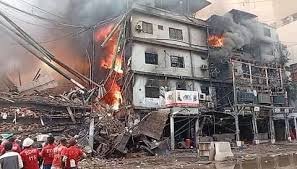
ISLAMABAD: Sindh’s provincial government has started an investigation following the fire incident at a prominent shopping center in Karachi, which resulted in the destruction of over 1,200 outlets and a personal loss of over 55 million dollars, 14 killed officials said on Monday. This also resulted in a partial loss of the main anchor of one of the busiest commercial areas of the city.
According to emergency service employees, the incident occurred on Saturday in the Gul Plaza building, which is located in the Saddar area of Karachi, and fire quickly spread through the multiple levels. Firefighters worked to gain control of the fire, and it continued to burn deep into the night on Sunday.
Recurring fatal incidents in Karachi’s commercial structures have also been a concern, and the city is an overcrowded one, home to more than 20 million people, where fire safety regulations, if any, and poor infrastructural development are leading to unnecessary loss of life and a deadening of the economy.
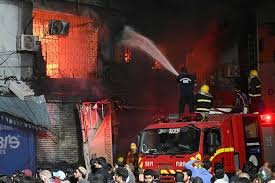
The Chief Police Surgeon of Karachi, Dr. Summaiya Syed Tariq, noted that things have gotten so bad that now, “Karachi fire death toll rises to 11.” “The fire has been put out, and smoke is rising, but the bodies are ready to be recovered,” says Muhamamd Amin, an Edhi official present at the location.
Considering the incident, Chief Minister Murad Ali Shah on Sunday evening instructed the Karachi Commissioner to conduct an immediate inquiry examining the extent to which the catastrophe was the consequence of some failure to ensure the relevant safety regulations or some other procedural oversight.
\”In the statement, Fire safety measures in the building should be ascertained, and if there is any negligence or carelessness, appropriate action should be taken\”.
The cause of the fire remains undetermined. The police said a formal investigation will begin once the firefighting operations are complete.
Shah was told that the fire consumed over 1,200 shops, destroying decades of investment and inventory.
Firefighting crews were able to bring 60 to 70 percent of the fire under control, and cooling and rescue operations continued into Sunday, which resulted in the death of one firefighter.
After the incident, Shah spoke to the press and explained the timeline and other details regarding the response, saying the fire was under control in a matter of minutes.
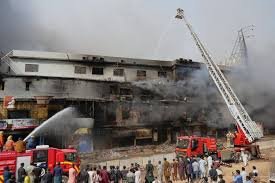
The Chief Minister, recounting the firefighting efforts, stated, “The first fire tender arrived on the scene at 10:27 p.m. and the operations commenced right away. To complete the operation, the Pakistan Navy and the Civil Aviation Authority assisted, while 26 fire tenders, 4 snorkel vehicles, and 10 water bowzers were on the scene.’”
Rescue and cooling operations were still ongoing when Shah explained that the preliminary data suggested a range between 58 and 60 people that were unaccounted for due to the fire. Additionally, the fire triggered the peak wedding shopping season, resulting in economic losses to the traders and shoppers impacted by the fire.
The firefighters faced challenges due to the entry points, which were limited, and the intensity of the blaze, which resulted in the magnitude of the damage increasing.
A loss of 10 million dollars has been amassed by the business community, which has been greatly impacted by the tragedy.
The Karachi Chamber of Commerce and Industry (KCCI) has stated that in order to manage relief efforts, record the losses, and advocate for compensation and resettlement for the traders affected by the disaster, a specialized committee has been formed.
KCCI articulated preliminary evaluations indicating that families became economically inactive as more than 1,000 small and medium-sized enterprises were entirely obliterated. The chamber referenced both the 2009 Bolton Market arson and subsequent destruction of fire-affected markets, and the provision of funds to support the 2,000 affected. The Bolton Market incident, and subsequent destruction of fire-affected markets, and provisions of funds, serves as precedent to both the provincial and federal government to formulate a special compensation package for affected SME families.
Trader’s representative, Ateeq Mir, stated the fire loss to businesses is estimated to be in excess of $10 million.
“There is no compensation for life, but we will try our best that the small businessmen that have encountered losses here… we will try in a transparent manner to compensate their losses,” Chief Minister Shah said.
In a separate incident, the premier’s office reported that Prime Minister Shehbaz Sharif spoke to Shah on Sunday to provide federal support in full to the provincial authorities.
Sharif emphasized that a “coordinated and effective system is essential” for the quick management of fires in highly populated cities and stressed the importance of further systems that would prevent similar disasters in the future. He stated that the federal government is willing to collaborate with the provincial government to create an integrated system for fire response and fire safety in the provincial Sindh. He stated that Islamabad has supported the affected families and the Sindh government in the case of the emergency.
Karachi is a commercial and business hub of Pakistan. It has one of the biggest commercial and business sectors in South Asia. It is one of the biggest cities in the world with a population of over 20 million people. Constructing a fire-fighting infrastructure in such a dense city, and such a large population, is extremely difficult. The obstacles that fire-fighting services have to face are illegally constructed buildings, other unregulated construction, and solid regulatory enforcement. Along with that, a lot of construction is done in such a way that the access routes are so narrow that they are impassable to fire-fighting vehicles, and such that they will further delay the rescue attempts. Buildings are frequently unregulated, and they self-constructed fire exits, and fire protection systems, such as sprinklers and fire alarms. The unprotected and unregulated fire and electrical wiring, over-loaded electrical systems, and flammable materials are a recipe for disaster in any construction. That is coupled with the construction, and in many cases, the buildings are so overpopulated that a fire will spread rapidly. Once a fire has started, the area becomes extremely dangerous for the fire-fighting services. The only option that they have is to enter the areas that are overpopulated with people, and are densely constructed. It places the fire fighters and the people in the area at a great elevated danger, and is a large and extreme danger. Once a fire has started to spread rapidly, the fire fighters will only have a small and limited space in which to work. It will be highly and grossly inadequate for the construction. It will be dangerous for everyone in the area. The danger to everyone involved is the greatest danger that there can be. The area that has been constructed and densely populated is the greatest danger in the world.