What does a business analyst do?
This question is popular among those who don’t know business analysts’ important roles within organizations, including understanding what the organization is trying to achieve and its options through technology. Business analysts review business processes to determine efficient ways to achieve the organization goal and identify problems. Knowing what a business analyst does can help organizations use the analyst’s insights and inform aspiring analysts of possible career paths.
What a business analyst does also means understanding the analytical, communicative and strategic skills of the business analyst that enables the analyst to transform business needs into available and actionable solutions. This paper articulates the responsibilities of the business analyst, the tools and competencies needed, and the organizational value business analysts add.
Responsibilities of a Business Analyst
One of the areas of expertise of a business analyst is the process of refinement of the business processes. Business analysts analyze business processes, identify areas that need improvement, and develop solutions that align with the organization’s objectives.
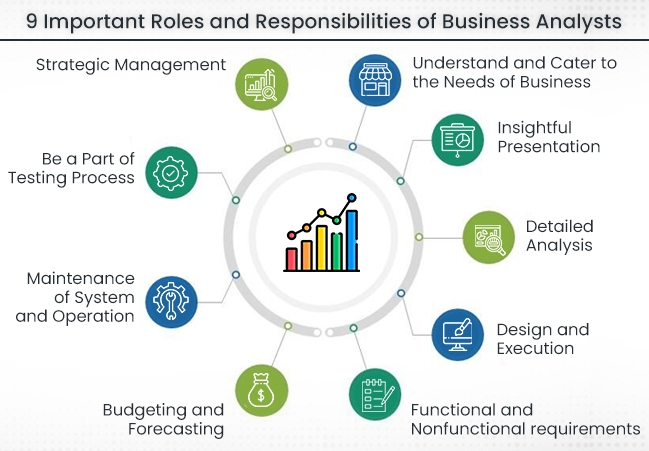
These tasks are often varied but are inclusive of the following;
1. Collecting and Analyzing Requirements
A business analyst’s tasks can include collecting and analyzing the project requirements. Business analysts facilitate the project’s stakeholders, like managers, employees, and customers, to document the functional and nonfunctional requirements of the business case. They help to clarify requirements to mitigate project misunderstandings.
2. Improving Processes
Business analysts are often hired to examine business processes that are inefficacious, in order to understand the business’s existing processes to find out the inefficacious areas in order to enhance the efficiency of the business. They conduct workflow analyses and process improvement recommendations to set time and cost efficiencies, and to enhance the overall productivity. Their recommendations are derived from metrics and a wealth of data.
3. Designing and Validating Solutions
A business analyst is able to understand the business objectives and requirements, and from that point, the business analyst is able to begin the development of solutions. Solutions can include the development of business software, other business workflows, and the development of new business models and processes. Business analysts are able to validate these solutions and processes through stakeholder analysis and testing in order to determine whether the intended goals of the business have been achieved.
4. Communication and Stakeholder Management
Each business analyst’s role also involves the communication and coordination between the technical teams, and the business stakeholders. They are the ‘go-betweens’ using and describing technical speak to people who are not technically oriented, and getting everyone aligned to the same project objectives.
5. Reporting and Documentation
Business analysts are responsible for keeping reports and documents detailing processes, and specifications for the requirements. This helps for tracking the project and referencing for the future, and measuring success. Their documentation is what ensures that even when a team member walks away, a knowledge gap is not created.
Essential Skills Required by a Business Analyst
To appreciate what a business analyst does, you should also appreciate the skills that help them do what they do, and do them well. Business analysts must have a combination of both technical and soft skills.
Analytical Thinking
Business analysts are expected to have great analytical skills. This is important for evaluating business issues, making sense of the data, and recognizing the patterns. Analytical thinking is what drives and justifies the recommendations a Business analyst makes.
Communication Skills
Effective communication is critical. A Business analyst must have the ability to speak, and write, to a range of stakeholders, and present even the most technical documents, in the most straightforward, simple, and direct manner.
Being an analyst requires more than just business acumen, and not every analyst needs to be a developer, analysts must have a strong understanding of relevant technologies, and frequently some understanding of databases, software development, and even analyst tools like SQL, Excel, and business intelligence software.
Analysts tend to be strong problem solvers, and must address challenges in an organization’s workflows, processes, and technologies, and devise ways to circumvent obstructing factors through the implementation of new processes.
Business analysts achieve a great deal through the application of some basic tenets of project management, which assist the analyst in organizing work, achieving milestones, and promoting project success.
Analysts must have strong familiarity with the tools that facilitate their work.
- Excel and Google Sheets for analysis and reporting
- JIRA and Trello for project task and requirement tracking
- SQL for data and database query and extraction
- Power BI and Tableau for reporting and data visualization
- Visio and Lucidchart for flowchart and process diagram construction
Analysts are very much needed in every industry where data driven decision making and process optimization are necessary. This includes:
Finance and Banking – Assessment of financial systems, compliance, and risk analysis
Healthcare – Assessment of systems and processes of patient care and hospitals.
Information Technology – Assisting in the development of applications and systems integration.
Retail and E-Commerce – Improving customer satisfaction and the efficiency of the supply chain.
Government – Improving efficiency in the delivery of services and the digital transformation of processes.
Business Analysts Career Path
To understand what a business analyst does, it is also necessary to understand the career path involved. A business analyst typically begins his career as a junior analyst, where he is involved primarily in data collection and data analysis. Thereafter, he is expected to move to a senior analyst role, where he is responsible for leading a project and supervising the work of junior analysts. Some of them also tend to specialize in data analysis, system analysis, or strategic analysis.
For those wishing to move further up the career ladder, the CBAP (Certified Business Analysis Professional) and the PMI-PBA (Professional in Business Analysis) certifications are useful in demonstrating competence, as well as improving your career opportunities.
Business Analysts’ Challenges
Although it is a rewarding role, being a business analyst has a number of challenges.
Uncertain Requirements – Stakeholders do not always know what they require, therefore, analysts need to do a lot of clarifying.
Managing Conflicting Stakeholders – It can be extremely difficult to deal with a large number of clients, particularly when they have differing views.
The need to adapt – Analysts need to constantly adapt to the environment in order to keep up with technological changes.
Managing large amounts of data – It is often challenging to organize and manage large amounts of data in order to extract important information.
Conclusion
What is a business analyst? Simply put, a business analyst is a liaison between the business’s requirements and the technical solutions. Analysts evaluate and describe processes, requirements, and solutions, and explain how these solutions can improve business efficiency and productivity. To do this effectively, business analysts need a whole toolbox of analytical, communication, technical, and problem solving skills.
Understanding what a business analyst does allows an organization to know who to hire, while business analyst aspirants identify what they need to do to step into a successful career. The role is becoming a critical need to fulfil as organizations try to become value driven through the use of data and the technology available to them.
FAQs About Business Analysts
Q1. What education is required to become a business analyst?
Most business analysts have a bachelor’s degree in business administration, IT, finance, or related fields. Additional training and/or certifications can enhance career opportunities.
Q2. Is coding required for a business analyst?
Not necessarily. Some degree of technical knowledge, including SQL or data visualization, is advantageous, but coding skills are not a requirement for all positions.
Q3. How much does a business analyst earn?
Compensation is dependent on the level of experience and the industry sector. Business analysts just starting out can earn approximately $60,000 per annum, while business analysts in senior positions can earn in excess of $100,000.
Q4: Is it possible for a business analyst to work from home?
A: Yes, a number of companies provide flexible work arrangements, especially for positions that entail data analysis and reporting.
Q5: Which sectors require business analysts more than others?
A: Business analysts are in demand in finance, healthcare, IT, retail, and government.