Once you start to learn python, you quickly start to wonder, what is a float in python? A float is a number type where you can store, and work with, numbers that contain a decimal. Floats are used when you need more precision than whole numbers can offer. For example, if you are dealing with a measurement, the average of a set of numbers, or any scientific calculation.
In real projects, floats are very common. In data science, finance, gaming, and calculations, you will see floats everywhere. There are also a few “surprises” when it comes to floats, especially regarding rounding. Understanding those early will save you hours of frustration.
How Python Stores Floats
If you still wonder what is a float in python, think of it as a is a floating point number. These can be used to represent a whole bunch of numbers like 2.5, 0.1, -13.75, and 3.14159. The most important part to remember is that a float supports a decimal part.
When floats are stored in Python, they are stored as a binary number. Some decimals can not be perfectly represented and that is the reason you may see, or expect to see, 0.3, and instead you see 0.30000000000000004.
When someone asks what is a float in python? they should be answered with a float is a number type for decimals. But a float also has limits for precision due to how computers store it.
Float vs Int
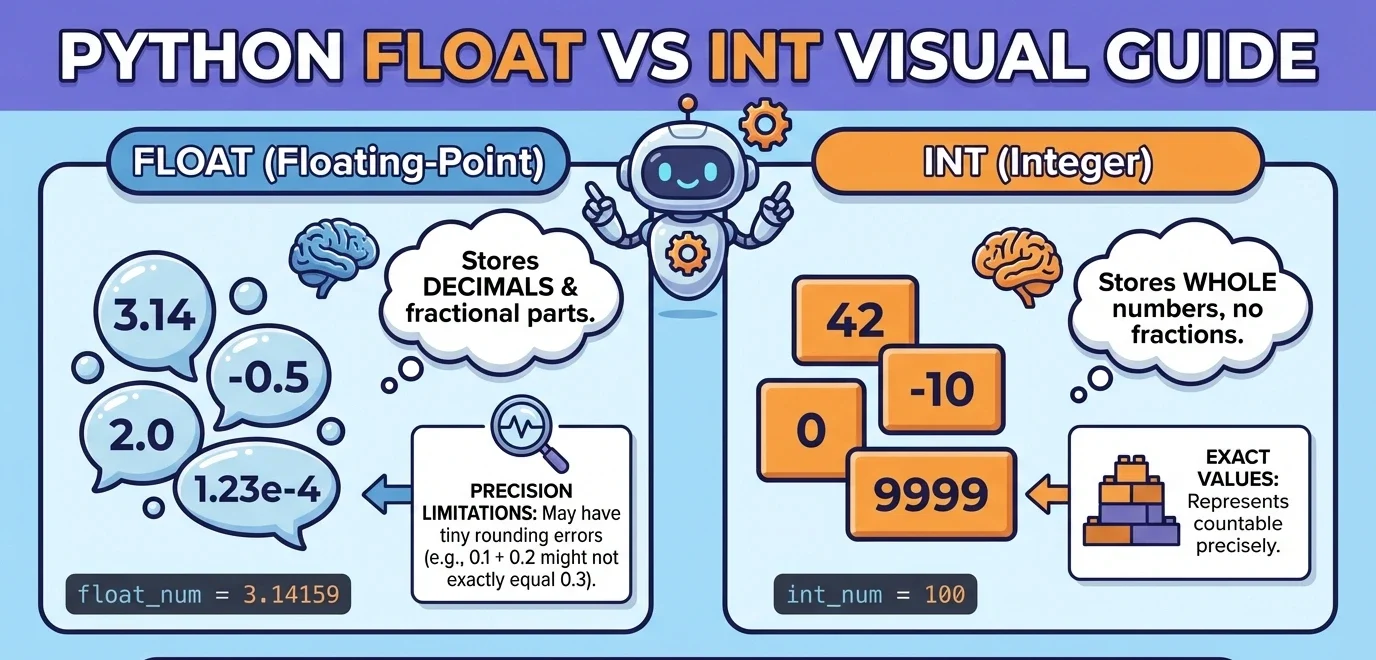
When you think about number types in python, the most basic comparison is float vs integer.
- Integer (
int) keeps whole numbers like 1, 50, -900. - Float (
float) keeps numbers with decimal places like 1.5, 50.0, -900.25.
Here is a better comparison:
| Feature | int | float |
|---|---|---|
| Can store decimals | No | Yes |
| Best for | counts, indexes, IDs | measurements, averages, rates |
| Precision | exact | can be approximate |
| Common risk | none | rounding and tiny errors |
Use integer when you are counting things. Use float when you need fractions.
Example of Floats Used in Real Life
Every day activities use floats:
- Measurements: Height, weight, distance, speed, temperature.
- Statistics: Averages, percentages, standard deviation.
- Rates: Interest rates, conversion rates, growth rates.
- Science: Calculations of physics, data from sensors, simulations.
- Graphics and games: Positions, angles, scaling, and animation.
If your values can be decimal, you are likely to use floats. In these cases, what is a float in python becomes a practical question because you need decimals to represent real-world values.
Storage of Floats (Why problems with rounding occur)
Floating-point numbers are stored in binary(which is base 2). Since decimal numbers are very easy to us, almost all decimal numbers are very simple, but in binary, they cannot be stored exactly (not all numbers are exactly representable). Instead, the computer stores the number which is the closest possible and reasonably representable.
This is how the float math ends up providing unexpected outputs. This isn’t a bug in Python; it is expected in the case of floating-point number representation which many languages end up using.
To put it simply, using floats is expected to be “close to the number” for most use cases, but it is not always exact.
A Common Surprise: 0.1 + 0.2
Many beginner programmers expect that 0.1 + 0.2 is stored in memory as 0.3. Since 0.1 and 0.2 are not stored precisely, this is not the case.
This is particularly true in case you:
- have stored financial float values.
- you have used the exact value in case of float.
- you have made a direct float value comparison.
It is better to compare float values with a very small tolerance. This is how float precision is dealt with.
What Does Float Precision Mean?
Float Precision refers to the number of digits that a number can reliably hold. A Python float type can hold about 15-17 digits, which is more than enough for most simple tasks. However, it is not unlimited. If you keep doing operations a number of times, you can build tiny errors that can get big quickly. These errors often occur in a large simulation or in a long sequence of calculations. If you need high accuracy, for example, in strict finance, then floats may not be the right option.
Float Rounding: Display Versus Actual Value
When printing out a float, Python will display it in a nice, clean way. However, the internally stored value may still have tiny extra digits. In general, rounding will impact how the number is displayed, and not how the number is stored.
- A float can appear ”rounded” on the screen, but it may still contain extra digits internally.
For a lot of user interfaces and reporting, rounding is good enough. If you need a more precise answer for strict calculations, then you will have to do something different.
Is It A Good Idea to Use Floats for Money?
Using floats for money can be a bad idea. When you add up a lot of numbers, like totals, taxes, or discounts, even small rounding errors can lead to big issues.
A way that is considered to be safer is when storing dollars and cents as whole integers instead of decimal based numeric storage, especially when they are going to be used for money. An example of this is using cents instead of dollars. The best method would be based on the implications of the project, though as a viable method, it is not reasonable to use float if it is necessary for it to be precise when dealing with money. When someone asks what is a float in python, the full answer includes this warning about exact currency calculations.
Converting Between Float and Other Types
In real life programming, when you are writing code, it is very common to change between different data types, and for the most part it is not a problem.
- An example of this would be changing a whole number to a number with a decimal place, for example, when changing the integer 5 to a float it would become 5.0.
- Regarding the other direction which is to change a decimal number to a whole number, this can change the meaning of the number because the whole effect is removed. An example of this would be changing the float 5.9 to the integer 5 because the decimal place would be removed.
This is especially important when dealing with user input and reading from files. Since a lot of the time, the data is recorded as text, it is best to change it into a decimal number and do the maths, and then change it back before displaying it.
This especially when dealing with important calculations, conversions, rounding, and trimming can be very important in making the data accessible.
Common Use Cases
1) Averages and scores
Averaging the scores, 80, 75, and 89, would result in a number that is not a whole integer, and in this scenario, it would be very reasonable to use a float because it would be able to preserve the fractional part.
2) Measurements
If you say the distance is 2.7 km or the temperature is 36.6 degrees C, you would need to use decimals. That’s exactly what floats are for.
3) Percentages
Discounts like 12.5% need a decimal. A growth rate of 0.08 also fits floats.
4) Machine learning and data science
A lot of model values are decimals. In this world, floats are standard for probabilities and weights.
Common Mistakes With Floats (And How to Avoid Them)
Mistake 1: Checking float equality directly
Because of tiny errors that floats can have, direct equality checks can fail. Instead, it makes sense to round values before comparing.
Mistake 2: Using floats for exact money totals
After several operations, small money errors will be created that floats can explain. If you need exact totals, use a safer strategy.
Mistake 3: Mixing float and int without thinking
They can be mixed in Python, but the type of the result may change. A calculation that starts as int can become float. That can affect later steps like formatting, indexing, or comparisons.
Mistake 4: Assuming rounding fixes everything
Rounding helps, but does not take away from the float nature. Use the proper tool, not just rounding.
Mistake 5: Ignoring input problems
User input and data file values may be messy. They have to be cleaned before conversion to float: “12,5”, “$12.50”. Many float bugs are caused by dirty input.
Best Practices when working with Floats
- For measurements, averages and scientific values, use floats.
- When precision matters, never directly compare for equality.
- Round for display, especially in reports, and UI.
- Using floats for money can be risky. Use safer storage methods.
- Keep calculations consistent. Don’t mix types without a reason.
- Test edge cases: very small, very large, and repeated additions.
Stable results, and ease in the logic are a result of these habits.
Summary
So, what is a float in python? It is the decimal number type in python and is used for numbers that include fractions, averages and measurements. It is important to note that the storage system of floats can cause rounding differences and that is normal in computing.
If you learn float limits beforehand, you can avoid mistakes and write cleaner, more reliable Python programs.
Common Questions
1) How is a float in Python used?
It is used for any numbers that have decimals, such as measurement, averages, and rates.
2) How is float different from int in Python?
int holds whole numbers. float includes decimals, and can even be approximate.
3) Why do floats sometimes show strange long decimals?
Because some fractions that are decimals can’t be accurately stored in binary, so Python saves a close value.
4) Should I use floats for money?
Usually not for strict accounting. Starting from a small amount, rounding mistakes can accumulate in the totals.
5) Are floats “wrong” in Python?
No. “Floats” function as “floating point numbers” in most other programming languages. You just have to use them in the right way.